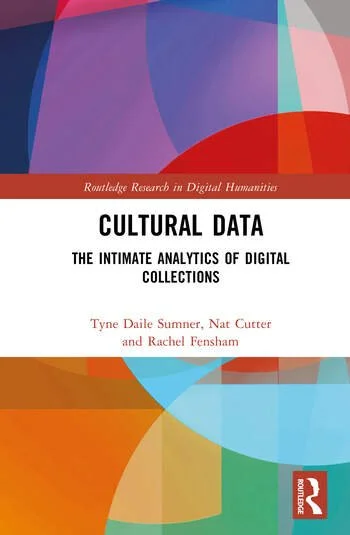
Cultural Data: The Intimate Analytics of Digital Collections (Routledge, 2026)
This book presents a timely and original study of the meaning, uses, and impact of cultural data today. Drawing on fields ranging from sociology and art history through to computer science and digital heritage, Cultural Data expands the possibilities for the study of arts and culture using computational methods at a critical moment for both national and global discussions about the future of digitisation and cultural data.
Combining computer-assisted quantitative research with qualitative and theoretical approaches, the book examines historical trends, demographic politics, and data cultures alongside experimental data visualisations that build distinctive narratives for the arts and creative industries. Through using and manipulating the open-source interoperability of arts and cultural data, the book presents new approaches, both theoretical and empirical, for telling stories about individual artistic careers, events, organisations, and networks. It also explores the unspoken, often hidden or obscured, content of cultural data: its murky histories, gaps, inconsistencies, silences and bias.
______________________________________

Small Data is Beautiful (Grattan Street Press, 2023)
Small Data is Beautiful investigates the conceptual, artistic, and computational qualities of small data. This original collection presents a challenge to discussions centred on big data – algorithms, surveillance and the datafication of human lives – by exploring the seditious and revelatory potential of radically rethinking data in creative research and practice.
Taking inspiration from the ‘small is beautiful’ mantra of the 1970s, a counter-cultural pursuit of planetary survival, the book interrogates the scale of the digital age through narratives, intimacies, representations, and ecologies. It offers a rich interdisciplinary dialogue from perspectives including cultural history, sociology, visual art, performance studies, musicology, literary studies, and data science.
“Small data and big data are two sides of the same coin, capable in their own ways of offering unique insights on political, social and economic life. As much as we benefit from the macroanalysis that big data facilitates, we are equally reliant on the microanalyses that small data offers – and each must inform each other.” — Roopika Risam, Associate Professor of Film and Media Studies and of Comparative Literature at Dartmouth.
“Working across disciplines, forms and practices, Small Data is Beautiful attunes us to the significance of the micro in a globalised and increasingly digitised world where scale and “bigness” rule.’ — Rebecca Coleman, Professor at the Digital Futures Institute, Bristol University, UK.
______________________________________
